
Cameroon 15 days, tribes and forests of Central Africa
Sleep in the forest with the Baka Pygmies. Climb the Alantika Mountains to Koma villages. Share dinner with a Fulani king. Cross Cameroon from the Adamawa plateau to the Dja Reserve.
Authentic Africa Travel. Off the beaten track.
Why visit Cameroon
Cameroon is one of the best destinations in Central Africa. The country counts 250 different tribes. Animists, Christians and Muslims live together in peace.
The West is the mountain area. Many treks are organized there.
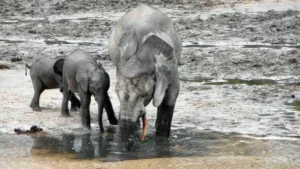
The East is famous for Lobeke National Park. The park hosts several forest animals, including gorillas and elephants.
From November to April, the country hosts many festivals. It is an important time to be in Cameroon to see one of them.
Cameroon deserves its nickname: Africa in one.
Trip overview in numbers
| Item | Detail |
|---|---|
| Duration | 15 days |
| Regions covered | Centre, Adamawa, North, East |
| Tribes met | Koma, Fali, Fulani, Bororo, Baka, Badjoué |
| Nights in tents | 4 nights |
| Nights in train | 2 nights |
| Main parks and reserves | Dja Reserve, chimpanzee sanctuary |
| Fitness level | Intermediate |
Itinerary day by day
Day 1: Europe to Yaounde
Arrival in Yaounde. The guide welcomes you. Transfer to the hotel.
Accommodation: AZUR or similar hotel. Bed and breakfast.
Day 2: Yaounde to Ngaoundere by train
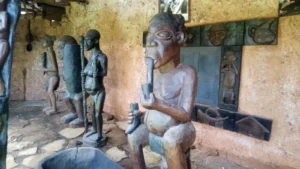
Breakfast. Explore Yaounde town. Visit the African Art National Museum and Mount Febe for the landscape.
Lunch. Stop at a bakery to buy food for the train.
Night on the train. Bed and breakfast.
Day 3: Ngaoundere, Gouna, Hoy, Poli (5 hours)
Arrival in Ngaoundere in the morning. The city is the capital of the Adamawa Province. It plays an important economic role in the region. It connects northern Cameroon and Chad with the port of Douala by train. The city has cattle and cotton.
The city keeps a medieval atmosphere around the Lamido palace, the Sultanate, despite its economic growth.
After a short visit, descent from the Adamawa plateau toward the Benoue Valley. You feel a change of climate while going down. Spectacular views of this African plain open before you.
After 20 kilometers, the modern villages around Ngaoundere, made of cement and corrugated iron, disappear. Only traditional adobe villages remain along the tar road.
Stop for lunch in a local market on the way to Poli, capital of the Faro Valley. The meal includes grilled meat, corn, sweet potatoes, bananas and biscuits.
Afternoon arrival. Installation at the hotel. Dinner under the African sky.
Accommodation: hotel in Poli. Half board.
Day 4: Poli, Wangay (4 hours), Librou, Alantika Mountains
Early breakfast. Drive to Wangay, the last Cameroonian border before Nigeria. Cross the Faro River. Enter one of the very old traditional places in the region.
Greeting to His Majesty of Wangay, a Fulani king. Lunch. Trek to reach one of the first Koma villages.
A local guide and carriers take care of the tents, food (rice, pasta, sardines) and bottled water.
You reach Librou, an animistic community hidden inside the Rocky Mountains.
Night in tents. Full board.
Day 5: Librou to Nagamalou, Alantika Mountains
Early breakfast. Visit of the village. Departure to Nagamalou, another Koma village.
Walk around 3 hours to reach the village. Welcome by the Djaouro, the local chief. Bathing in the nearby stream before lunch.
With the local guide, you interact with the Koma people. They have not seen many foreigners yet.
Night in tents. Full board.
Day 6: Nagamalou, Wangay, Poli or Fignole
Early breakfast. Beginning of the descent to the plains. There are many ways to go back to Wangay.
You try to walk down the path that crosses the Mbororo camp, settled nomads.
You reach Wangay and continue to Poli or Fignole.
Night in Poli or Fignole. Full board.
Day 7: Poli to Garoua (4 hours)
Breakfast. Departure to the capital of the North. Arrival in Garoua. Installation at the hotel.
Visit the local market and the town. Relax at the hotel in the afternoon.
Accommodation: hotel in Garoua.
Day 8: Garoua to Bonia Djallou, Fali village (2 hours)
Enter a Fali animist tribe. One of the most interesting peoples in the north of Cameroon. They live far from big cities and keep old traditions.
Meet the chief of the village. Explore their culture. Talk with local people. Discover their social system.
After a day visit, return to Garoua and relax at the hotel.
Accommodation: hotel in Garoua.
Day 9: Garoua to Ngaoundere (6 hours)
Breakfast. Return by car to civilization. Stop in some Bororo villages on the way. Visit them.
Stop at one of the local weekly markets. Continue to Ngaoundere.
Installation at the hotel. Visit the Sultan palace and the market.
Night at the hotel. Bed and breakfast.
Day 10: Ngaoundere, waterfalls, crater, Idool Fulani village
Breakfast. Drive to Tello waterfalls, among the most beautiful in the region. The landscape is wonderful on the way.
Continue to one of the welcoming Fulani villages. Idool teaches you about Fulani tribes in Cameroon. It is a real community in the area. The people open their doors to every traveler who passes around the village.
The King, the Lamido, and his family open the gate and welcome visitors. Installation in a guest house. Meet the King family at the palace. Visit the village with some princes. Have lunch and dinner with a family. Keep good feelings with local people.
Night with a host family in Idool. Full board.
Day 11: Ngaoundere, waterfalls, crater, Idool Fulani village
Breakfast. Return to Ngaoundere. Lunch.
Visit the Tison crater lake in the afternoon. Transfer to the train station. Night on the train.
Night on the train. Bed and breakfast.
Day 12: Yaounde, Akonolinga, Somalomo (5 to 6 hours)
Arrival in Yaounde. Departure by 4×4 to the remote East. A partly tarred and dirt road takes you through a panoramic scenery of jungle, colonial plantations and old German towns such as Akonolinga. You also pass picturesque mud villages inhabited by Bantu-speaking people.
Picnic box lunch on the way to Somalomo, the last urban town before entering the wild Dja Reserve, a UNESCO World Heritage site.
In Somalomo, Mama Rose and her family welcome you. These friendly people are your hosts, cooks, guides and friends during the stay in the region.
Dinner under the stars.
Night in tents or in a simple local hostel. Half board with dinner.
Day 13: Somalomo, Dja Reserve, Baka Pygmy camp (2 hours walk)
Breakfast at Mama Rose’s. Visit to Somalomo town after the bureaucratic paperwork at the police station.
In this town, most inhabitants belong to the Badjoue culture. This ethnic group has lived in this area of the jungle since the 17th century, when they migrated from Congo.
The Badjoue people have lived with the Baka Pygmies for centuries. They adopted Christianity and cocoa farming for a living, complementary to hunting and logging, since the German colonization.
Despite modern elements visible in Somalomo, many houses are built in the traditional Bantu style of bamboo, palm leaves and red mud.
After this visit, jungle expedition. Cross the Dja River, a tributary of the mighty Congo River. Walk through the jungle accompanied by a park guard, a native guide and carriers with tents, food and bottled water.
Some of the Baka camps are only 1 hour walk from the river. Others sit 4 hours away. The walk is quite gentle. Some muddy areas and a couple of streams remain practicable for most travelers.
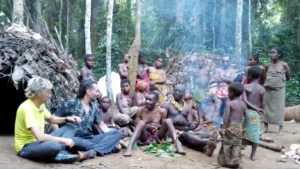
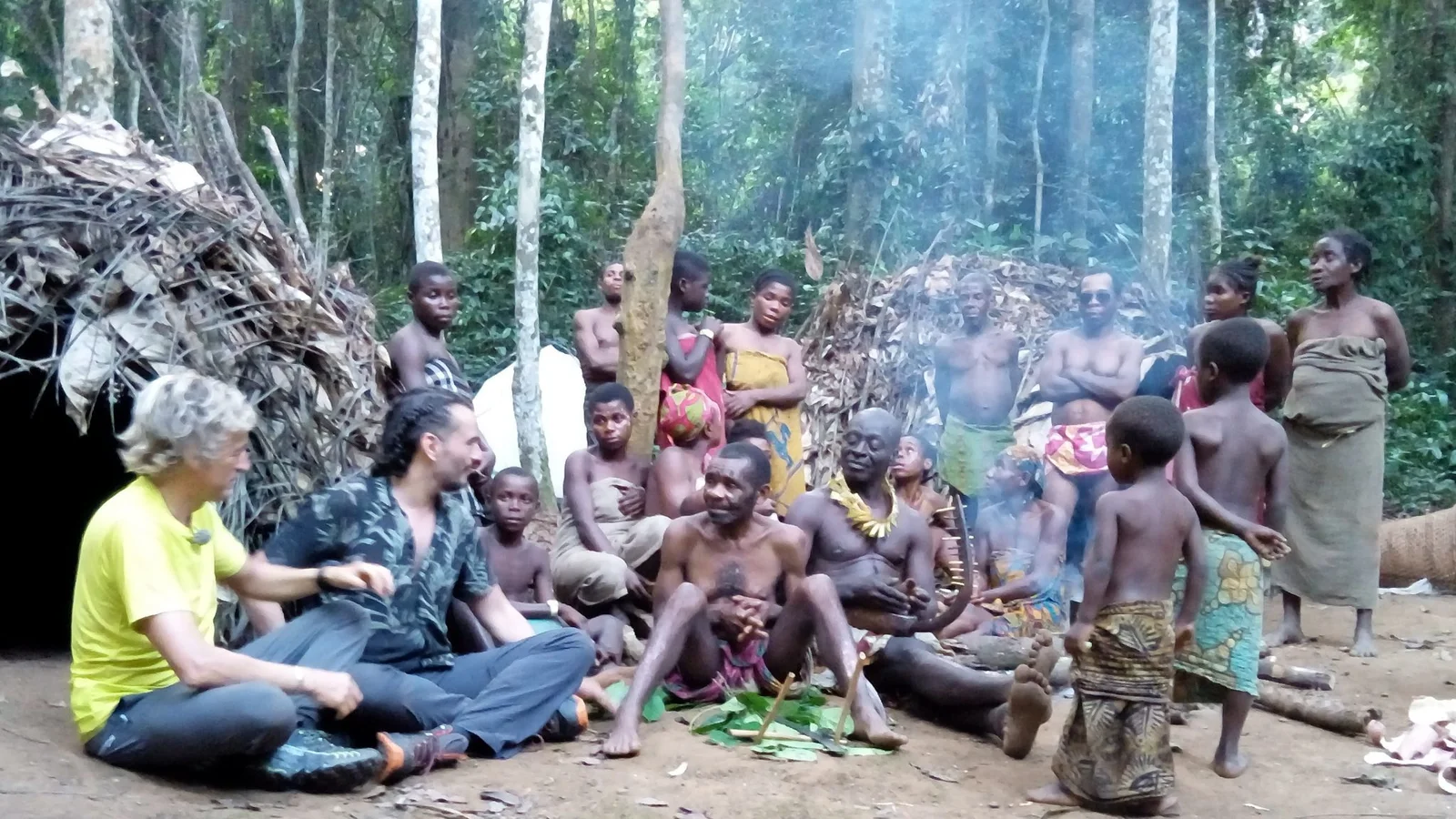
Present yourself to the different Pygmy families when you arrive at the Baka camp. Ask before taking any pictures of the whole scenery, which is very impressive.
Relax. Leave your backpack in a dry area. Bring pictures of your family, home or pets to show. It eases the first contact. The local interpreter greatly helps to exchange information between guests and hosts.
Dinner at the camp. Sometimes the polyphonic yodels of Baka women rise in the night. A breathtaking experience.
Night in tents. Full board.
Day 14: Baka camp, Somalomo, Akonolinga, Yaounde (5 to 6 hours)
Breakfast in the middle of the jungle. Basic wooden seats are provided for breakfast and other meals.
That morning, you live a day with the Baka. They show you their early activities. You learn about their vision of life and other socio-cultural aspects.
After this intense cultural experience, farewell to your hosts. Return to civilization. Departure to Yaounde via the colonial town of Akonolinga. Lunch on site.
Short visit to the old German quarter. Drive to Yaounde. A hot shower cannot wait for long.
Night at Azur Hotel. Bed and breakfast.
Day 15: Yaounde, Edea, departure
Breakfast. Visit the town, the National Museum, the Mount Febe landscape and the handicraft market for last shopping.
Dinner. Transfer to the airport. Last assistance. Goodbye Cameroon.
This trip is an example. For a precise quote, contact us.
Trip highlights
| Highlight | Location |
|---|---|
| Night in the forest with the Baka Pygmies | Dja Reserve |
| Night with the Koma tribes | Alantika Mountains |
| Visit to the Bororo, Fali and Fulani tribes | North region |
| Dinner with the Lamido of Idool | Idool |
| Train journey from Yaounde to Ngaoundere | Centre and Adamawa |
| Kola nuts and Fulani kingdom encounter | Wangay |
Practical information

Cameroon
Republic of Cameroon
| Government | Republic |
| Official languages | French and English |
| Capital | Yaounde |
| Economic capital | Douala |
| Total area | 475,650 km2 |
| Time zone | UTC +1 |
| Population | Around 28 million inhabitants |
| Currency | Central African CFA franc (XAF) |
| Calling code | +237 |
| Visa | E-visa online. Required. |
| Vaccines | Yellow fever mandatory. Diphtheria, tetanus, polio recommended. |
| Best period | November to February, dry season and festivals |
Price includes and does not include
| Included in the price | Not included |
|---|---|
| Transport during the whole trip | International flight |
| Guides and local guides | Tourist visa |
| Accommodation in hotels and camps | Meals and drinks not specified |
| Full board in Poli and Dupas, except drinks | |
| Full board with the Pygmies in the Dja Reserve, except drinks | |
| Motor pirogue at the Chimpanzee Sanctuary Reserve | |
| Activities and visits mentioned in the itinerary | |
| Entries and taxes at the Chimpanzee Sanctuary |
Budget per person
| Item | Estimated amount |
|---|---|
| Round-trip international flight | 600 to 1,200 euros |
| E-visa | 50 to 100 euros |
| 15-day all-inclusive tour | 2,500 to 4,000 euros |
| Tips for guides and porters | 100 to 200 euros |
| Souvenirs and crafts | 50 to 150 euros |
Equipment to bring
| Category | Item |
|---|---|
| Sun protection | Hat, sunglasses, sunscreen |
| Luggage | Waterproof bag for clothes. Small bag for the forest. |
| Shoes | Plastic sandals, Tevas, surf shoes or rain boots |
| Optics | Binoculars, camera, 400 mm lens |
| Insect protection | Insect repellent, long-sleeved shirt, long trousers |
| Security | Security locks |
| Lighting | Head torch with batteries |
| Rain | Raincoat, poncho, small umbrella |
Important notes
- The order of visits and excursions can change based on local conditions, such as road state or market days.
- If some visits cannot be done due to external conditions, they are replaced when possible.
- Distances between cities and towns are long. Roads and tracks are often in bad condition.
- Bring one big bag for the trip and one or two backpacks.
- We provide essential travel material such as life vests, tarps, machetes and a chain saw if needed.
Abbreviations
| Code | Meaning |
|---|---|
| RO | Room only |
| BB | Bed and breakfast |
| HB | Half board. Breakfast and lunch or dinner. |
| FB | Full board. Breakfast, lunch and dinner. |
Ready to discover Cameroon
Tell us what you want to see and experience. We build your tailor-made itinerary.
Contact us to start planning your authentic Cameroon trip.